Frequently Asked Questions
Common questions about water damage restoration in Fort Worth, TX — first steps, who to call, insurance claim deadlines, mold licensing and flood zones.
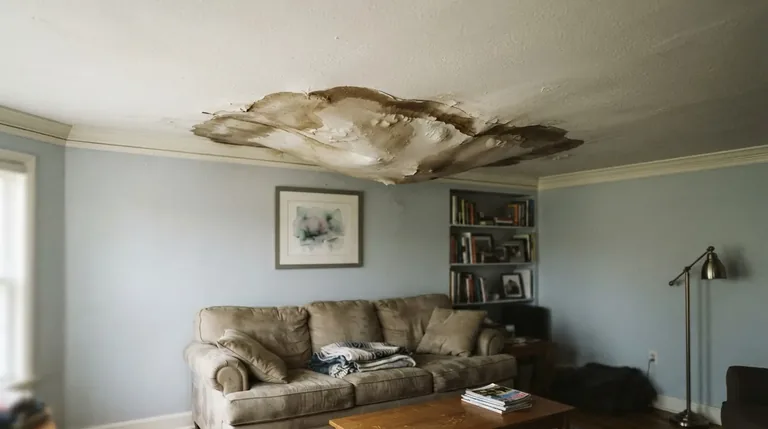
Who to Call First in Fort WorthWhat is the first thing to do about a ceiling leak in Fort Worth?
Check for two hazards first: a sagging ceiling that could fail, and water near a light fixture or outlet. If it is safe, cut power to the area and use your home's main water shut-off valve. Then call the city's water emergency line, 817-392-4477, Option 1, if the water or sewer system may be involved.
Does a stain directly under the leak show exactly where the water came in?
Not necessarily. Treat the stain's location as a clue, not a diagnosis. Ask a roofer, plumber or restoration provider to find the actual source before any ceiling repair, and photograph the stain and the area around it first for your insurer. If a pipe above the ceiling is involved, a plumber is the one to repair the line itself.
Can I throw away a wet, sagging piece of drywall right away?
Photograph it first. Keep damaged materials until your insurer has had a chance to review them, unless they present a health or safety hazard, such as an unstable ceiling section that could fail.
Can my policy cap what it pays for mold after a ceiling leak?
It can. The Texas Department of Insurance has published mold endorsements with limits set at 25%, 50% or 100% of dwelling coverage, so there is no single standard mold limit. Check your own declarations page and endorsements. Mold is generally excluded except for repair work tied to a covered loss, and your policy wording controls. This is general information, not insurance advice.
Who do I call if my repair attempt does not fix the problem?
Call the water emergency line again if the issue may involve the city's system. For damage strictly inside your home, contact a plumber — ask for proof of any trade license the work requires — or a local restoration provider, and check the site's who-to-call-first guidance for other options.
Where is Fort Worth's Development Services Department located?
Development Services is at City Hall, 100 Fort Worth Trail, Fort Worth, TX 76102. Call 817-392-2222 with questions about whether your ceiling repair needs a permit before you start work.
Is 817-392-4477 the right number for a burst pipe inside my house?
It depends on the location. For a break on the city side, such as a water main, call 817-392-4477, Option 1. A break inside your home's plumbing is your responsibility; see the frozen and burst pipe guide above for what to do next.
Who is the Fort Worth floodplain administrator?
Lisa Biggs, P.E., CFM, is the floodplain administrator, reachable through Stormwater Management at 817-392-6261 or floodplain@fortworthtexas.gov. Contact that office with questions about flood risk, floodplain permits, or a property near mapped flood-prone areas.
Is the flood-risk consultation from the city actually no cost?
Yes. The city offers personalized consultations at no cost for properties in or near flood-prone areas, including a site visit on request. Contact the office at 817-392-6261 to ask about scheduling one for your property.
Does flood insurance start the day I buy it?
Usually not. NFIP coverage generally has a 30-day waiting period, but exceptions apply. Confirm your policy's effective date with your agent.
Who is responsible for the sewer line between the street and my house?
The city is responsible for sewer collectors, mains, and outfalls within public rights of way and easements. The customer service line running from the main to your house is the homeowner's responsibility to maintain and repair.
Do I need a permit to repair flood damage to my home?
Ask Development Services, at 817-392-2222, before work starts. Whether a permit is required depends on the scope of the repair and, in some cases, on whether the property is near a mapped flood-prone area.
Does homeowners insurance cover burst pipes in Fort Worth?
Most standard policies generally cover sudden and accidental water discharge, which includes a pipe that bursts. A slow, ongoing leak is commonly excluded. Your specific policy wording controls what is paid, so this is general information, not insurance advice.
How many claims came from Winter Storm Uri?
The Texas Department of Insurance reported 510,772 claims statewide across all lines of insurance, as of March 31, 2022. That total is not limited to water damage and is described by TDI as a snapshot, not a final figure.
How long does my insurer have to respond to a burst-pipe claim?
Under Texas Insurance Code §542.055, the insurer must acknowledge your claim not later than the 15th day after receiving notice, or the 30th business day for an eligible surplus lines insurer. Other deadlines apply once the insurer has your documents and once it agrees to pay; see the deadline table above.
Should I hire a public adjuster after a pipe freezes and splits?
A public adjuster is optional; you are not required to hire one to file or pursue a claim. If you hire one, Texas law caps their commission at 10 percent of the settlement, and they cannot charge a percentage fee if the insurer pays or commits in writing to pay the policy limit within 72 hours of the loss report.
Is a frozen pipe the same as a slab leak?
No. The terms describe different things: freezing concerns the pipe's condition, while a slab leak concerns a leak beneath the foundation. See the slab leak guide for that separate topic.
Can my insurer get extra time after a major winter storm?
Yes, in some cases. Under Texas Insurance Code §542.059(b), in the event of a weather-related catastrophe or major natural disaster, as defined by the insurance commissioner, the claim-handling deadlines in that subchapter are extended for an additional 15 days. Your insurer should still acknowledge and work the claim; ask it which deadlines apply to your claim if a statewide storm is involved.
Who do I call first for a Fort Worth water or sewer emergency?
Call the City of Fort Worth's water emergency line, 817-392-4477, Option 1. For flood-risk or floodplain questions, contact Stormwater Management at 817-392-6261 or floodplain@fortworthtexas.gov instead, and for a building or repair permit, call Development Services at 817-392-2222.
Can my home flood if it is not in a FEMA flood zone?
The City of Fort Worth's flood-risk letter says heavy rainfall from localized thunderstorms is the primary cause of flooding in the city and that these events can occur year-round. Check your specific address in the Flood Risk Viewer rather than assuming a mapped floodplain tells the whole story.
Where can I check my property's flood risk before I buy flood insurance?
Use the City of Fort Worth's Flood Risk Viewer or look up your address in OneAddress under its Flood Risks section. The city also offers a flood-risk consultation and site visit at no cost for properties in or near flood-prone areas.
Which rivers run through Fort Worth?
The West Fork and the Clear Fork of the Trinity River both run through Fort Worth. The Tarrant Regional Water District manages a 27-mile floodway along the river. Creeks and storm drains matter too: the city says heavy rainfall from localized thunderstorms is its primary cause of flooding, so check your own address in the Flood Risk Viewer rather than judging risk by distance from the river.
How can I get alerted about flooding in Fort Worth?
Sign up for CodeRED alerts through the City of Fort Worth's emergency management office to get notified before or during a flood event in your area. That is a separate step from checking your address in the Flood Risk Viewer or OneAddress.
When does freezing weather usually arrive in Fort Worth?
The National Weather Service office in Fort Worth lists November 22 as the average first freeze and March 12 as the average last freeze for Dallas/Fort Worth. These are averages, not limits, so a freeze can come earlier or later in a given year. If a pipe does split, the frozen and burst pipe guide for Fort Worth covers insurance and claim deadlines.
Do I need a license to clean up mold in my own Fort Worth home?
Not always. Texas law exempts an owner working on residential property they own with fewer than 10 dwelling units, with no area limit on that exemption. For hired remediation work, the under-25-contiguous-square-foot exemption may apply. That area exemption does not apply to assessment.
What does “25 contiguous square feet” actually mean?
It is the exact size threshold Texas law uses to decide whether a company you hire for mold remediation needs a state license. It is not “about 25” or “near 25” — the statute uses that specific figure, and it applies to remediation, not to assessment.
Can the same company assess and remove my mold?
Under Texas law, the same license holder generally cannot perform both mold assessment and mold remediation on one project. Ask which role a company is performing for you, and confirm a different license holder is handling the other role if you need both.
What is a certificate of mold remediation?
It is the document Texas law requires a licensed remediation company to give the property owner, due not later than the 10th day after the work is completed. It documents that licensed remediation was performed; it does not by itself prove the underlying leak is fixed.
Does my homeowners policy cover mold removal?
Usually only in a limited way. The Texas Department of Insurance says mold is generally excluded except for repair tied to a loss your policy does cover. Some endorsements set a sublimit — 25%, 50% or 100% of your Coverage A — so check your own policy.
I am selling my house. Do I need to show mold paperwork to the buyer?
Texas law requires an owner to provide copies of mold remediation certificates from the preceding five years to a buyer when selling residential property. Keep any certificate a licensed company gave you after remediation work, since you may need to hand it to the buyer at closing.
Where do I file a complaint about mold work or an insurance denial?
For a mold licensing question, contact the Texas Department of Licensing and Regulation, which administers chapter 1958. For an insurance coverage question or a complaint about how your claim was handled, contact the Texas Department of Insurance at 800-252-3439. Keep your certificate of mold remediation and your claim documentation when you reach out.
Does it matter how the water got there — burst pipe, roof leak, or sewage?
Chapter 1958 does not sort mold jobs by water source. The licensing thresholds turn on the size of the affected area and on whether the work is assessment or remediation. How contaminated the water was is a separate, practical question for the cleanup plan, not for the license.
What does a slab leak look like from inside the house?
Possible observations include a water bill that rises with no new use, a warm or damp patch on the floor, the sound of running water when everything is off, or damp carpet and a musty smell in one area. These do not establish the source; a plumbing inspection can confirm it.
What should I ask a plumber before a slab leak repair?
In Texas, plumbers are regulated by the Texas State Board of Plumbing Examiners. Before work starts, ask the plumber for proof of insurance and any trade license the job requires, and ask for an itemized written estimate that separates finding the leak, reaching the pipe and repairing it. If the floor or walls also got wet, ask who will handle drying and rebuilding.
Should I call a plumber or a restoration provider first?
A plumber finds and fixes the leaking line; a restoration provider dries out and repairs the damage the leak already caused. If water is actively escaping, avoid electrical hazards and contact a plumber or the appropriate utility. A plumber can investigate the suspected leak.
Can clay soil actually cause a slab leak?
Texas A&M AgriLife Extension describes North Texas soil as heavy clay. That does not establish the cause of a leak at your home. Clay soil is background, not a diagnosis: a plumber can investigate whether the moisture comes from a leaking pipe.
What if I am not sure it is a slab leak at all?
A plumber can investigate whether the moisture comes from a leaking pipe rather than another source, such as a roof leak, a fixture leak, or condensation forming near the floor. When the cause is unclear, get a professional opinion rather than guessing.
If a builder's work caused my slab leak, what should I do?
Texas's Residential Construction Liability Act requires you to send the contractor written notice by certified mail at least 60 days before filing a claim. During the 35 days after the contractor receives that notice, the contractor may inspect the property, including up to three inspections, before you proceed. Texas Property Code chapter 27 sets these rules.
Is there a typical price for water cleanup in Fort Worth?
The national figures below are not Fort Worth-specific prices. According to Angi (2026), the national range is $450–$16,000, with an average of $3,868. These are national survey figures, not a quote for your home. Ask the provider assessing your damage for a written, itemized estimate.
What is included in a typical restoration estimate?
A written estimate should separate extraction and drying, demolition of materials that cannot be dried, and rebuilding, plus any mold-related work called out on its own. Comparing it task by task against what your insurance adjuster approved is easier than comparing two lump-sum totals.
Does my deductible determine what I pay out of pocket?
Your deductible, set in your policy, is the amount you pay before coverage starts; the restoration provider does not set it. Ask your insurer how your policy terms, deductible, and the documented damage affect payment.
What is the NFIP premium reduction in Fort Worth?
Because Fort Worth participates in the National Flood Insurance Program and the Community Rating System, the city says residents can get flood insurance with premiums 15% lower than without that participation, according to a September 2025 city letter to floodplain property owners.
Why do two restoration estimates for the same damage differ?
Providers can scope a job differently — one may include more demolition or a different drying approach than another. Ask both for a written, itemized estimate and compare task by task rather than comparing only the total.
Is there a calculator to estimate my cost?
No. Water category, affected area, materials, and how long they stayed wet all change the scope of work, so a generic calculator would not reflect your specific damage. A written estimate from a provider assessing your home is the accurate way to get a number.
Full guides on this site
- Ceiling Water Damage in Fort Worth, TX: What to Check First
- Flood Zones and Water Shutoffs in Fort Worth, TX
- Frozen and Burst Pipes in Fort Worth, TX: What to Know
- Mold After Water Damage in Fort Worth, TX: The Texas Rules
- Slab Leak Water Damage in Fort Worth, TX: What to Do First
- Water Damage Restoration Cost in Fort Worth, TX
Water in your home right now?
See who to call first in Fort Worth, how to reach your water provider, and how to check your flood zone.
Who to Call First in Fort Worth